I had a week once where things were actually good. Not “I’m coping” good but genuinely, surprisingly good. Sleep was happening. Meals were happening at times that made sense. I was even responding to texts within hours instead of letting them rot in my inbox for days while guilt piled up. And I remember this feeling, this thought that crept in like maybe I’d finally cracked the code. Like okay, this is it. I’ve crossed over to the other side.
Then Thursday showed up.
I couldn’t tell you what set it off. Maybe nothing did. Maybe everything had been quietly stacking and I just didn’t notice. But I woke up and there it was, that heaviness sitting on my chest like something physical, something with weight. Getting out of bed felt like trying to move through wet concrete. By lunchtime I was sitting in my car in a grocery store parking lot, crying, because they didn’t have the yogurt I wanted. The specific one. And even while it was happening I knew, somewhere underneath it all, that the yogurt wasn’t the thing. It’s never the yogurt.
That night I ended up on my bathroom floor thinking: well, there it is. Square one. All that progress just evaporated. I’ve completely failed at this.
But here’s what I’ve figured out since then, what I really wish somebody had said to me in that moment. I wasn’t at square one. I was having a hard day. And those two things? They’re not the same thing at all.
Somewhere we all absorbed this idea that healing is supposed to look like climbing a mountain. You start at the bottom, miserable, and you work your way up. Each day slightly better. Each week a little lighter. Step by step until you reach the top and you’re done.
It’s a tidy picture. Makes sense on paper. And it has almost nothing to do with how healing actually happens.
Real healing is more like weather. Some days the sun’s out. Some days it pours. Sometimes you get this long gray stretch that seems like it’ll never lift, and then one random morning you wake up and light’s coming through the window and breathing feels easier and you didn’t do anything to make it happen. The storm wasn’t proof you were broken. The sunshine isn’t proof you’re fixed. It’s all just the same sky doing what skies do.
I think we push back against this because it feels unfair. We want the effort to count for something concrete. We want to say I did the work, so I should be better now. And the work does matter. It does. But the timeline? That part isn’t something we get to decide.
So let’s talk about what’s really going on when you have a terrible day, or week, or month, right after things were starting to feel okay.
It’s not failure. It’s not evidence that nothing’s really changed. It’s not the universe sending you a message that you don’t deserve to feel better.
A setback is usually just this: your nervous system reacting to something. Maybe stress that built up without you realizing. Maybe a grief anniversary your body remembers even when your mind forgot to mark the calendar. Maybe exhaustion finally catching up. Hormones doing their thing. The accumulated weight of pretending everything’s fine becoming too much to hold.
Your body isn’t turning against you. It’s trying to tell you something. And the message isn’t “you’re hopeless.” It’s usually closer to “I need something right now.”
And sometimes? Sometimes there’s no message at all. Sometimes hard days just show up. The brain is complicated and weird and not everything comes with a tidy explanation. That’s frustrating, I know. But it’s also kind of freeing once you stop demanding a reason for every dip in the road.
Here’s something I want you to sit with, especially if you’re reading this in the thick of a hard stretch and wondering whether anything’s actually different.
Think about the last time you felt this low. Not to rank your suffering or anything like that. Just to notice: what’s different about how you’re handling it?
Back in my early twenties when depression hit, I’d vanish. Weeks would go by. I’d stop answering my phone entirely, convince myself that everyone was secretly relieved when I wasn’t around. I let the darkness swallow me whole because I genuinely didn’t know there was another option.
Now when hard days come, I still struggle. Of course I do. But I also do things I couldn’t do back then. I’ll reach out to someone, even if it’s just one text to one person. I try to eat something. I remind myself, even when I don’t fully believe it, that this will pass eventually. I’m gentler with myself while I’m in the middle of the mess.
That’s not nothing. That’s actually everything.
Progress isn’t the absence of bad days. Progress is what you do inside of them.
One of the genuinely hard parts of healing is learning to hold two truths at the same time.
You can be getting better and still have terrible days. You can have come so far and still feel like you’re drowning. You can be proud of yourself and also bone-deep exhausted.
These aren’t contradictions. They’re just what it looks like to be a human being moving through something hard.
I had this conversation with a friend a few years back. I was apologizing, again, for being “too much.” For having another rough week after I’d promised myself I was finished with rough weeks. She looked at me and said something that I still think about constantly: “You’re not too much. You’re just going through a lot. Those are different things.”
She was right. And maybe you need to hear that too. You’re not too much. You’re not failing at this. You’re not back at square one just because today feels heavy.
You’re going through something. And you’re still here. That matters more than you realize.
I’m not going to hand you a list of steps to “overcome” setbacks. I don’t think that’s actually useful. But I can tell you a few things that make hard days a little more survivable for me.
Lowering the bar way down. On bad days my only goal is to get through. That’s the whole list. No productivity. No self-improvement. No best version of myself nonsense. Just making it to the other side. And that’s enough.
Telling one person. Not for advice. Not so they can fix it. Just so I’m not completely alone in it. Sometimes I’ll text a friend something like “having a rough one” and they’ll say “that sucks, I’m sorry” and somehow that tiny acknowledgment takes some of the weight off.
Remembering that feelings aren’t facts. When my brain starts telling me I’ll never feel better, that everyone secretly can’t stand me, that I’m a burden on everyone around me, I try to remember: this is the hard day talking. It’s not true. It just feels true right now.
Being kind to tomorrow’s version of me. Even when I feel hopeless I try to do one small thing for the person I’ll be when I wake up. Drink water. Set out clothes. Go to bed instead of doom-scrolling until 2am. It’s tiny. But it’s a small vote for a tomorrow that might be gentler.
What if we stopped measuring healing by how we feel on our worst days? What if we paid attention to how we move through them instead?
What if setbacks weren’t evidence that something’s wrong, but just part of the terrain?
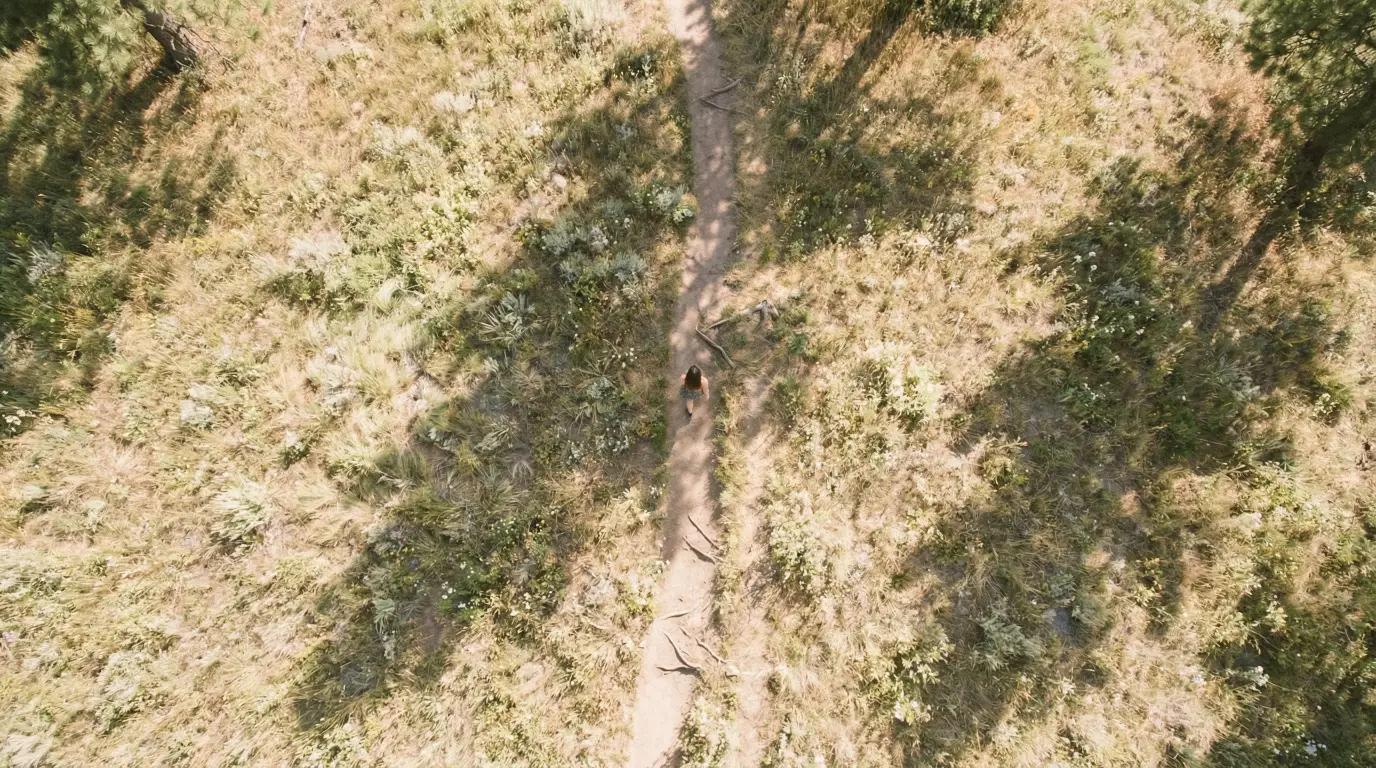
What if the path forward isn’t a straight line going up, but more like a spiral? Where you keep passing through familiar places but you’re a little different each time you come around?
I don’t have this all figured out. I’m still in the middle of learning it myself. But I do know you’re not back at square one. You can’t unlearn what you’ve learned. You can’t unfeel the moments of peace you’ve had, even if they feel impossibly far away right now.
The hard day will end. Not because you white-knuckled your way through it heroically. Just because that’s what days do. They end. And when it passes, you’ll still be here. Still healing. Still moving forward even when it doesn’t feel like movement at all.
That’s what “not linear” actually means. It means there’s no timeline you’re supposed to be meeting. It means the setbacks are part of the thing, not proof that the thing isn’t working.
You’re doing better than you think. Even today. Especially today.